Discover the Space Capabilities Catalogue—your single, free resource for exploring the UK’s dynamic space sector. Whether you’re looking for supply chain partners, academic expertise, or infrastructure insights, this comprehensive guide connects you to key players driving innovation and growth in the industry.
The UK space sector is rapidly evolving, driven by innovation, collaboration, and a shared vision for leadership in space exploration and technology. As this sector expands, the need for a comprehensive, accessible, and detailed overview of its capabilities becomes increasingly critical. This is where the Space Capabilities Catalogue (SCC) comes into play.
The SCC is not just a directory, it is a dynamic platform designed to map and explore the breadth of the UK space sector. By bringing together data from industry, academia, and infrastructure, the SCC provides a unified dataset that offers unparalleled insight into the strengths and opportunities within the UK’s space ecosystem.
One of the primary challenges the SCC addresses is the fragmentation of information across the space sector. With hundreds of organisations, academic institutions, and infrastructure facilities dispersed across the UK, it can be difficult to gain a holistic understanding of the sector’s capabilities. The SCC solves this by offering a single, authoritative source of information that stakeholders can rely on to navigate the complexities of the space industry.
Moreover, the SCC plays a crucial role in supporting the discovery of solutions to emerging challenges. Whether it’s identifying key industry players for potential partnerships, understanding the distribution of academic expertise, or locating critical infrastructure, the SCC is a valuable tool for informed decision-making. It also serves as an educational resource, providing insights into the real-world applications of space technology, and helping to inform policy development that supports the growth and sustainability of the sector.
By fostering greater transparency and accessibility, the SCC seeks to strengthen the UK’s position in the global space industry. This catalogue is more than a tool—it is a vital asset in our collective effort to propel the UK to the forefront of space exploration and technology.
If you haven’t already, we encourage you to register for the platform to explore these resources and discover how you can contribute to the UK’s thriving space sector.
Industry
The industry segment of the SCC maps organisations within the UK Space Ecosystem. It provides a profile for each organisation, their geographic locations, and economic data. It utilises a comprehensive taxonomy to provide a detailed view of the UK’s space supply.
The SCC can support the discovery of solutions to emerging challenges, inform policy development, and act as an educational resource for understanding diverse aspects of space technology and its real-world applications.
If you’d like to learn more about how to use our taxonomy, you can find out more here.
Academia
The Academic Expertise Portal (AEP) within the SCC maps the Academic Ecosystem related to space research and innovation in the UK and provides insights into the UK’s strengths and capabilities. The AEP is designed to enable users to navigate the space ecosystem and identify institutions to engage, consult, and collaborate with. The AEP utilises similar language and definitions to the industry side of the SCC to allow for ease of use and comparative analysis between industry and academia.
For a practical example of the AEP in action, check out our latest case study and recent demo webinar.
Infrastructure
The SCC has recently ingested data on existing Infrastructure within the UK Space Sector. Whilst this domain is in its infancy for the SCC, it is now host to a comprehensive Infrastructure map outlining facilities and equipment available to the Space Sector across the UK. This resource can help stakeholders understand available facilities, their locations, and how to access them.
Speakers for Schools are coordinating a three-day virtual work experience programme designed to introduce young people to the exciting opportunities within the UK space industry. As a valued organisation within the Space East cluster, your involvement—whether through a guest talk or a project challenge —will help students gain real insight into the sector while showcasing your work to future talent.
This is a fantastic opportunity to support skills development and raise awareness of the dynamic careers available in space. Get involved and help us launch the next generation of innovators!
Dates: The exact dates will be determined by industry volunteer availability; however the placement will occur within the window of late June – early July.
Time commitment: Across the 3 days we would like at least one industry volunteer to join us, for an hour (or more!) to speak about their career, current job role, provide some pointers on entering the sector, and give some general input on the project work the students will be completing. This is all hosted virtually through Google Classroom, and we provide full training and support; as well as template slide-decks to use if you do not have your own resources.
On the final day, students will be presenting their projects back to the group for feedback, of course it would be great to have someone from industry on the call to provide their feedback too, this usually would take around an hour.
Are you an HR professional working in the UK Space sector? Does your UK space organisation have a dedicated HR team?
A group of passionate HR professionals in the UK space sector are establishing ConstellHR, a peer-to-peer network to:
–Knowledge share: Discussing how topical HR issues can be addressed in space-specific contexts
– Foster collaboration: Driving HR innovation and enhancing the core employee value proposition across the sector
– Support development: Sharing opportunities for space-specific professional development for HR colleagues
Once established, ConstellHR aims to provide a supportive and collaborative environment for HR peers to collectively drive
sector growth through effective people management strategies. ConstellHR is free to join, and will host bi-monthly calls for you to
share knowledge and expertise with your HR peers.
To find out more, contact info@spacepartnership.org.uk, or search “ConstellHR” on LinkedIn
The £1.2m grant made available through an agreement with the Department for Business & Trade will support SME’s adoption and implementation of industrial digital technologies through impartial advice and guidance, a digital roadmap, and leadership and management development programmes to upskill the workforce.
Match-funded grants of up to £20k will also be made available for the adoption of new technologies in the financial year 2025-2026.
In the pilot year, it is estimated there will be 130+ engagements with businesses, 80 digital roadmaps completed, and 20-30 intensive support sessions of 10+ hours. Roughly 24 match-funded grants of up to £20k are expected to be awarded. Training cohorts will support around 20 senior business leaders with their vision for a digital manufacturing business; around 24 operational managers to adopt and implement industrial digital technologies; and 12 digital interns will be supported with matchmaking between regional universities and businesses.
Made Smarter is an Industry and Government partnership committed to realising the ambitions set out in the 2017 Made Smarter Review, namely how UK manufacturing industries can prosper through digital tools and innovation. It identified a range of benefits to the UK manufacturing sector over 2017-2027 from the improved adoption of Industrial Digital Technologies, including £455bn additional GVA; 30% productivity increase; 175,000 new jobs and a 4.5% reduction in C02 emissions.
Businesses from the East of England can register for this support which starts from the 1st April 2025 on the national Made Smarter Adoption Website
Cllr Fabian Eagle, Cabinet Member for Economic Growth, said: “Manufacturing and engineering is one of the key sectors in Norfolk and the Made Smarter Adoption East of England programme closely aligns with the priorities set out in the Norfolk Economic Strategy.
“It also gives the county council the opportunity to lead a key, national and internationally significant programme dedicated to supporting the advanced manufacturing and engineering sector in the East of England and help establish and nurture an important strategic partnership with DBT for future opportunities.”
Following the recent integration of the New Anglia Advanced Manufacturing and Engineering (NAAME) sector support programme into Norfolk County Council, Made Smarter Adoption has resulted from wider conversations with an East of England upper tier authority stakeholder group, working closely with the Department for Business Trade and Make UK.
The Made Smarter East of England Programme Board, tasked with monitoring the delivery of the programme, will consist of a private sector chair, industry representation and representatives from across the six upper tier authorities in the East of England: Norfolk, Suffolk, Essex, Hertfordshire, Bedfordshire and Cambridgeshire.
NAAME Chair Jamie Thums MBE said: “The rollout of the Made Smarter Adoption programme in the East of England represents a pivotal moment for our manufacturing sector. It’s not just about adopting new technologies — it’s about empowering leaders to future-proof their businesses, drive productivity, and cultivate a culture of innovation.
“For manufacturers in our region, this initiative provides the tools and confidence to compete on a global stage while building a sustainable and skilled workforce for the future.”
The Calnex team are really looking forward to joining our Space East colleagues on the Space East stand (No: 2926) at the forthcoming Farnborough International Space Show (FISS) 19-20 March 2025, billed as a new, annual UK space industry event to pioneer the commercial space age and advance space domain defence.
If you are considering deploying applications or services over Satellite (LEO, GEO, MEO, VSAT etc.) networks or NTN (Non-Terrestrial Network) environments you will want to know that they are going to have the resilience to cope with the inevitable changes in network conditions they will encounter when operating in the space or NTN environment. And this is where we can help, because we provide the capability to create controllable & repeatable test networks on demand. Using our solutions you can stress test your applications and services prior to their deployment so that when they are deployed in real-world networks you can be confident they are going to work. In addition, all this can be achieved without the prohibitive costs associated with live satellite trials.
Come and visit us on the Space East stand as we would be delighted to share our experience and knowledge of working on projects for the likes of the European Space Agency, Satellite Applications Catapult, Surrey University and the MOD (although we obviously won’t go into much detail on any military use cases).
We look forward to meeting you there but if you can’t get to FISS 2025 you can always contact us – just email satellite@calnexsol.com
The European Space Agency (ESA) Planetary Defence Office is closely monitoring the recently discovered asteroid 2024 YR4, which has a very small chance of impacting Earth in 2032.
This page was last updated on 29 January 2025.
Asteroid 2024 YR4 has an almost 99% chance of safely passing Earth on 22 December 2032, but a possible impact cannot yet be entirely ruled out.
The asteroid is estimated to be between 40 m and 100 m wide.
It is too early to determine where exactly on Earth a potential impact could occur.
Two UN-endorsed international asteroid response groups are considering their next steps.
As our asteroid survey technology improves, we are likely to detect an increasing number of objects passing close to Earth that we would have missed in the past.
What do we know?
Near-Earth asteroid 2024 YR4 was discovered on 27 December 2024 at the Asteroid Terrestrial-impact Last Alert System (ATLAS) telescope in Río Hurtado, Chile.
Shortly after its discovery, automated asteroid warning systems determined that the object had a very small chance of potentially impacting Earth on 22 December 2032. 2024 YR4 is estimated to be between 40 m and 100 m wide. An asteroid this size impacts Earth on average every few thousand years and could cause severe damage to a local region.
As a result, the object rose to the top of ESA’s asteroid risk list. Since early January, astronomers have been carrying out priority follow-up observations using telescopes around the world and using the new data to improve our understanding of the asteroid’s size and trajectory.
As of 29 January 2025, ESA estimates that the probability that asteroid 2024 YR4 may impact Earth on 22 December 2032 is 1.2%. This result is consistent with independent estimates made by NASA’s Center for Near-Earth Object Studies (CNEOS) and NEODyS.
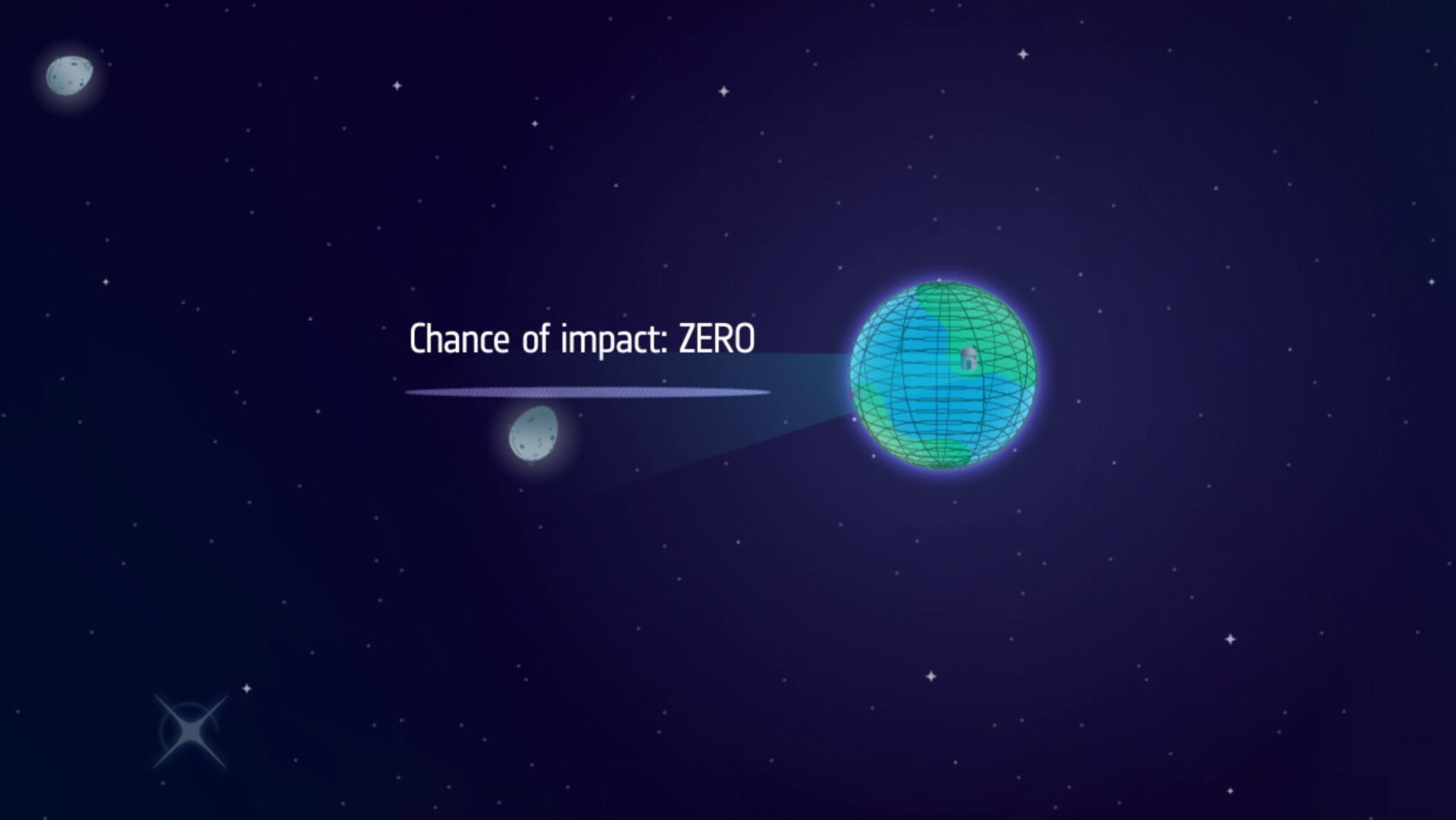
Asteroid 2024 YR4 is now rated at Level 3 on the Torino Impact Hazard Scale: a close encounter that warrants attention from astronomers and the public. It is important to remember that an asteroid’s impact probability often rises at first before quickly dropping to zero after additional observations. For an explanation of why this happens, see the video below:
Asteroid 2024 YR4 is estimated to likely be larger than 50 m and has an impact probability higher than 1% at a point in time within the next 50 years. It therefore meets all of the criteria necessary to activate the two UN-endorsed asteroid reaction groups: the International Asteroid Warning Network (IAWN) and the Space Mission Planning Advisory Group (SMPAG).
The International Asteroid Warning Network
IAWN, chaired by NASA, is responsible for coordinating the international group of organisations involved in asteroid tracking and characterisation. If appropriate, IAWN would develop a strategy to assist world governments in the analysis of asteroid impact consequences and in the planning of any necessary mitigation responses.
ESA is a member of IAWN and is now coordinating additional observations and regularly updating its risk assessment.
The asteroid’s orbit around the Sun is elongated (eccentric). It is currently moving away from Earth in almost a straight line, making it difficult to accurately determine its orbit by studying how its trajectory curves over time.
Over the next few months, the asteroid will begin to fade out of view from Earth. During this time, ESA will coordinate observations of the asteroid with increasingly powerful telescopes, culminating in the use of the European Southern Observatory’s Very Large Telescope in Chile, to gather as much data as possible.
It is possible that asteroid 2024 YR4 will fade from view before we are able to entirely rule out any chance of impact in 2032. In this case, the asteroid will likely remain on ESA’s risk list until it becomes observable again in 2028.
Near-Earth asteroid 2024 YR4 observed with the European Southern Observatory’s Very Large Telescope in January 2025. Credit: ESO/O. Hainaut et al.
The Space Mission Planning Advisory Group
SMPAG, chaired by ESA, is responsible for facilitating the international exchange of information, developing opportunities for collaborative research and missions, and conducting near-Earth object threat mitigation planning activities related to asteroid 2024 YR4.
The Group will convene at its existing planned meeting in Vienna next week to determine its next steps. If the asteroid’s impact probability remains above the 1% threshold, SMPAG will provide recommendations to the UN and may begin to evaluate the different options for a spacecraft-based response to the potential hazard.
At ESA Space Solutions, ESA can help you launch your great ideas using space to solve challenges on Earth. In a drive for a sustainable future, they support businesses of all sizes and across sectors to develop innovative solutions using space technology. You can go to them with an exciting concept – and they provide you with financial support, technical expertise, business mentoring and access to our networks.
Space assets like satellite data or spaceflight technologies offer vast, untapped opportunities to your business. Whether you are an entrepreneur or an established business, we have a range of funding opportunities to support you in the development of commercially sustainable products and services:
Open Calls for Proposals
You can propose products and services in any sector at any time. We also have thematic calls, which are open for a limited period and address specific needs and themes. Take a look
Competitive Tenders
You can also submit proposals in response to one of our regular open competitions. These are directed at a specific challenges or opportunities. Take a look
The Prepare for Space initiative has been created to help non-space entities enter the space sector and allow for the cross-fertilisation of ideas, innovations and technologies. While this opens up obvious connections between, for example, the aerospace and space sectors, there are many other less obvious connections between space and other industries. One such industry is nuclear, which can draw a number of parallels with the space sector.
Origins
The origins of both industries date back to the time of World War Two (WWII), the beginning of the Cold War, and the nuclear arms race. Both industries were accelerated by military spending and defence requirements following the dropping of the first atomic bomb (‘Little Boy’) on Hiroshima, Japan, at 8:15am on 6 August, 1945, by the USAAF B29 bomber, `Enola Gay.’
With the end of WWII, geopolitical tensions grew between power blocs in the East and West, leading to a nuclear arms race and, subsequently, an advancing of missile technology, which developed into the Space Race from 1955 and the launch of the first artificial satellite, Sputnik 1, by the Soviet Union in 1957.
This Space Race between Cold War rivals, the Soviet Union and the United States, led to rapid advancements in space technology, having drawn from the ballistic missile-based nuclear arms race between the two nations following World War II.
As the space sector began to develop, nuclear research was also adding additional areas of focus alongside bomb technology to include naval propulsion and electricity generation.
From Military to Industry
Although both industry sectors had their origins in military / defence purposes, the following decades saw their remits grow to include civil and infrastructure purposes too.
For the space sector, this has seen the growth of communications, observation and navigational satellite technologies that have many terrestrial applications, including GPS systems used by vehicles and mobile devices.
From 1956, the main objective of the nuclear sector pivoted away from military applications and towards energy and the technological development of reliable nuclear power plants.
Despite the expanding of focus for both the nuclear and the space sectors, there remained competition between the East and West power blocs in both. This competition has increased further in recent years as other nations outside of the traditional competitors are developing their own space and nuclear industries.
Public Vs Private Sector?
The space and the nuclear sectors both tend to be supported by public sector investment, including in Britain with the UK Space Agency and the UK Atomic Energy Authority. This public sector oversight is also evident with the European Space Agency and national nuclear power initiatives across Europe.
However, there are many other nations, such as Japan, Peru, Saudi Arabia and Thailand, who are now investing in their own space programmes. Elsewhere, India’s Chandrayaan-3 lander and rover mission successfully landed on the Moon on 23 August 2023, making India the first nation to successfully land a spacecraft in the lunar South Pole region, and the fourth country to soft land on the Moon after the Soviet Union, the United States and China. The global public sector expansion of space is matched by a growth in the number of nations considering, planning, or implementing nuclear power programmes. Meanwhile, state-owned nuclear companies from Russia and China have been offering nuclear power plants to emerging nations.
Although the public sector remains integral to both space and nuclear programmes, both industries are also experiencing increased private sector interest. In space, this includes everything from high-profile businesses like SpaceX and Virgin Galactic to the 3,000 small businesses that deliver elements to the ESA space programme. Space collaboration has seen NASA working with industry and international partners on increasingly complex missions, while around 95% of commercial space programme growth is due to the launch of the Starlink satellite constellation, owned by Elon Musk’s SpaceX.
This growth in private investment is also emerging in the nuclear and fusion sectors, with over 35 private companies having raised over $2.4 billion to explore fusion concepts. The private fusion industry has grown quickly with varying levels of technology, strategy, and funding, mirroring the growth of private entrepreneurialism in the space sector.
Technology Needs
Because the nuclear and the space sectors share a number of technology needs, any solutions have the potential to cross from one industry to the other. These shared technology needs include:
Harsh Environments: Both industries have to cope with extreme temperatures and the effects of thermal cycling. In addition, the nuclear industry needs to assess structural changes caused by fusion and the impact of magnetic fields. The space sector also has to account for atomic oxygen and the need for parts to be lightweight. However, safety issues are also paramount in both sectors, with a requirement for assets to be able to be used safely over a number of years.
Radiation Shielding: Both industries need to account for radiation. In space, this requires shielding materials that are lightweight yet still offer a high performance to improve the lifetime of electronic equipment. Nuclear systems also require complex calculations for shielding and dosimetry. Of course, the main difference between space and nuclear is that the space sector needs to protect from radiation coming in from outside, while nuclear works to contain the radiation inside and prevent it getting out.
Technology Developments
The requirements of both sectors have led to a number of technology developments including advanced materials, technologies and automation, all of which have shown applications in both nuclear and space.
Oxide Dispersion Strengthened (ODS) Alloys: Oxide dispersion strengthened (ODS) alloys have found applications in both space and nuclear. In the space sector, NASA’s alloy GRX-810 is an ODS alloy capable of withstanding temperatures in excess of 2,000⁰F while also being able to last over 1,000 times longer than other state-of-the-art alloys. While these alloys have found increasing use in space (and aerospace) applications, they have also crossed over into the nuclear industry, with Texas A&M University researchers demonstrating the superior performance of a new ODS alloy they developed for use in both fission and fusion reactors. The high radiation resistance of these alloys offers applications in both sectors.
Ceramics and Composites: Ceramics and ceramic matrix composites (CMCs) are used in space applications, such as in the manufacture of lightweight turbine components that require less cooling air, such as vanes, blades, nozzles, and combustion liners, and parts for exhaust systems. Capable of withstanding temperatures as high as 1,600°C, CMCs are being considered to improve the performance and safety of nuclear fusion and fission reactors. Other materials used in the space industry include monolithic ceramic materials that have been used for mirrors, focal planes, optical benches and full structures in European space programmes for over 20 years. In nuclear, carbon-fibre reinforced composites have seen numerous improvements for use in experimental fusion reactors due to their high thermal conductivity, which dissipates the intense thermal flux generated by the plasma in a fusion reactor.
Additive Manufacturing: Additive manufacturing (AM) is being used in an increasing number of industries, including space where multi-million Euro contracts have been signed for the AM of satellite parts. There have also been investigations into using AM to build components in advanced nuclear reactors, with trials already underway across Europe, in the United States, and the Republic of Korea.
Automation and Robotics: The harsh environments associated with both sectors mean that automation and robotics are integral to both space and nuclear. The UK Atomic Energy Authority (UKAEA) and the Satellite Applications Catapult have partnered to demonstrate how advanced remote handling and robotics technology, originally developed for fusion energy research, can be used to provide maintenance for in-orbit satellites. Robotic technologies are already being used to install and replace small equipment, such as exterior cameras, batteries, and electrical system components. In-orbit servicing has seen around $600 million of investment by start-ups in the past five years as it allows astronauts to spend more time doing scientific experiments instead of going on risky spacewalks. The nuclear industry also has a growing history of using remotely-operated and autonomous tools to inspect, maintain, upgrade and decommission assets.
Industry Trends and Challenges
The technology advancements sought by both sectors are driven by industry tends and challenges, such as miniaturisation, Net Zero, managing waste and debris, and the challenges associated with working in an international, geopolitical environment.
Miniaturisation: Both sectors have been researching miniaturisation, although for different reasons. In space, the aim is to reduce weight and optimise payloads so as to reduce costs. With nuclear there has been a rise in the development of Small Modular Reactors (SMRs) and microreactors in what is the largest expansion of nuclear power in around 70 years. This will allow for plants to be spread to different areas and aid grid adaptation. Such reactors could cross over to space, where they could power bases on the Moon, while nuclear technology could also cross over into space propulsion.
Net Zero: Achieving Net Zero goals and reducing emissions will involve the space and nuclear industries. Nuclear energy has the potential to replace fossil fuels and reduce CO2 emissions. The space sector also has a part to play, from satellites to monitor emissions to orbiting solar reflectors that redirect sunlight to solar farms on Earth, extending the day for solar energy production.
Waste and Debris: Both industries have a requirement to deal with waste and debris in a safe and clean manner. With more satellites being launched, there are challenges around space debris cluttering up Earth’s orbit, while there are plans to bring the International Space Station (ISS) back to Earth to be disposed of in the Pacific in 2031. Of course, the challenges around nuclear waste are well-known, with a need to decommission old assets, even as new power plants are being commissioned.
International Challenges: The nuclear and the space sectors face international challenges around supply chains, regulation and resources. Import barriers and export controls have increased costs for parts that are not available locally, while international markets – particularly in the space sector – will require international regulation.In addition, the global challenge of cleaner energy and resources could see international tensions rise in what has been described as a new Space Race. This could, for example, involve helium-3, which could be used for nuclear fusion. Space could become important in this as only about 0.0001 per cent of helium on Earth is helium-3, but on the Moon there may be a million tonnes of this resource.
Culture
Both sectors are driven by innovation tempered by safety. Space tends to look towards a collaborative learning environment among employees, without which many profound discoveries and scientific advances would not have been possible. The nuclear industry places emphasis on procedural safety and a rules-driven approach, which leaves less room for innovative risk-taking and experimentation than with the space sector.
For the nuclear industry, safety is a combination of preventing accidents and security, which prevents intentional acts to harm the facility or steal nuclear materials. For space, safety leans towards communicating issues, testing, and learning from mistakes and successes.
Direct Links
While we have discussed the cross-over between the space and nuclear sectors in terms of technologies, needs and challenges, there have also been instances of direct involvement between the two industries. This includes the similarities in terms of decommissioning needs and how space can learn from the nuclear industry and the potential to use nuclear microreactors to power space craft.
While there are differences between the two sectors, there are also a great many similarities that open up the potential for spin in and spin out between the space and nuclear industries.
The Offshore Renewable Energy Catapult are running a series of Offshore Wind Market Access training sessions in the East of England in early February, which will focus on setting the scene for UK offshore renewables, highlighting the innovation support available and delving into data and digital developments!
Come along if you’re:
– Interested in the offshore wind sector and market needs
– Have a product, service or solution that can create insights from data
– Interested in understanding research gaps and market needs (specific to the Colchester session)
These sessions are delivered as part of the ‘Connect’ business support catalyst project. 𝐇𝐨𝐰𝐞𝐯𝐞𝐫, 𝐲𝐨𝐮 𝐝𝐨 𝐧𝐨𝐭 𝐧𝐞𝐞𝐝 𝐭𝐨 𝐛𝐞 𝐩𝐚𝐫𝐭𝐢𝐜𝐢𝐩𝐚𝐭𝐢𝐧𝐠 𝐢𝐧 𝐭𝐡𝐞 𝐩𝐫𝐨𝐣𝐞𝐜𝐭 𝐭𝐨 𝐚𝐭𝐭𝐞𝐧𝐝 𝐭𝐡𝐞 𝐭𝐫𝐚𝐢𝐧𝐢𝐧𝐠 𝐬𝐞𝐬𝐬𝐢𝐨𝐧𝐬! The sessions will feature speakers from the Connect project’s sponsors, ScottishPower Renewables and Equinor.
See links below to the various training sessions and please share with your contacts who might benefit!
Sharp Space Systems is an earth-imaging company developing innovative thermal imaging solutions to capture ultra-high resolution thermal infrared temperature maps. In collaboration with the University of Cambridge and supported by the European Space Agency (ESA), we are pioneering innovative solutions to capture and process thermal data from space. We are excited to announce our pilot program for thermal infrared data collection. This initiative involves using drones to capture thermal images and processing them to emulate the high-resolution satellite images that our space telescopes will produce once launched in Q4 2026.
We are seeking participants to help us collect thermal images of various areas, including:
Residential and industrial properties
Agricultural fields
Other areas of interest
Why Participate?
Free of Charge: This pilot is fully funded by ESA, so there is no cost to you.
Innovative Technology: Be among the first to experience and benefit from cutting-edge thermal imaging technology.
Benefits of thermal maps: Your participation will help demonstrate the value of our data set and advance space technology.
If you are interested in participating in our pilot program, please contact marco.gomez@supersharp.space. Your involvement will be instrumental in showcasing the potential of our thermal infrared data.
STEM-focussed youth charity, the Jon Egging Trust (JET), is appealing for new space partners in the East of England to offer access to their inspiring workplaces and employees as part of their long-term Blue Skies programme.
Blue Skies offers three years of structured support to local students, aged 12-15, who are facing adversity and hardship, and struggling with confidence at school. The programme supports students to build self-belief, self-worth, resilience, and employability skills, and offers access to extraordinary STEM workplaces and inspirational professional role models.
JET is growing rapidly in the East of England, and as a delivery partner of the UK Space Agency’s Space to Learn programme already works with over 60 military and aerospace partners across the UK including Northrop Grumman, BAE Systems, RAL Space, the CAA and the RAF. The charity’s youth team are experienced at adapting their programme delivery to suit diverse working environments which capitalise on the expertise and unique experiences of each partner’s workforce.
If you or your organisation think you might be able to support JET’s students, please reach out to our Area Director East, Jenna Cannell at jenna@joneggingtrust.org.uk. More information about JET’s programmes can be found at www.joneggingtrust.org.uk.
Kinetic Adventure is a space-themed Discovery Centre, (a registered Charity) located on the outskirts of Ipswich, and we’re about to celebrate our 11th year! Our Discovery Centre is in its fourth year, and our customer base, including schools, groups, and families, continues to grow each year. But we need your help!
Due to the overwhelming interest in our Outreach programme, we’re looking to expand our capacity. Kinetic is home to a mobile pop-up Planetarium and is the only one in East Anglia (as shown below), which travels to schools, venues, and groups. On average, our Planetarium welcomes over 16,000 visitors annually—and we want to grow that number even further, with the potential to reach 25,000 people each year.
Inside the Planetarium, we explore the night sky, highlight star constellations, show a short film about our Solar System, and another film about careers in the Space Industry.
So, how can you help us, even with our already successful Outreach programme? We’re aiming to purchase a second dome, mirror box, and projector, allowing us to bring this incredible experience to an even wider audience. The young people studying Astrophysics, Aeronautics, and Engineering in the next 10 years are currently around 10 years old, and we need to engage them now to ensure a skilled workforce in the future.
What better way to showcase your industry, your organisation, and the wonders of space exploration than by connecting with this growing audience? We’re looking for about five organisations to partner with us in making this a reality, helping to showcase your name to at least 25,000 people every year—teachers, students, space industry professionals, and the general public.
We are aiming to raise £10k to fund the second dome and projector kit. Contact us to find out more and join us in inspiring the next generation of space pioneers!
Manage Cookie Consent
To provide the best experiences, we use technologies like cookies to store and/or access device information. Consenting to these technologies will allow us to process data such as browsing behavior or unique IDs on this site. Not consenting or withdrawing consent, may adversely affect certain features and functions.
Functional
Always active
The technical storage or access is strictly necessary for the legitimate purpose of enabling the use of a specific service explicitly requested by the subscriber or user, or for the sole purpose of carrying out the transmission of a communication over an electronic communications network.
Preferences
The technical storage or access is necessary for the legitimate purpose of storing preferences that are not requested by the subscriber or user.
Statistics
The technical storage or access that is used exclusively for statistical purposes.The technical storage or access that is used exclusively for anonymous statistical purposes. Without a subpoena, voluntary compliance on the part of your Internet Service Provider, or additional records from a third party, information stored or retrieved for this purpose alone cannot usually be used to identify you.
Marketing
The technical storage or access is required to create user profiles to send advertising, or to track the user on a website or across several websites for similar marketing purposes.